Built & run it · Ops system — multi-marketplace fulfillment · 2026
TTT Inventory & Fulfillment System
The internal system that keeps my brand from overselling across Shopify, Walmart, TikTok Shop, and Amazon while routing orders to the right hub.
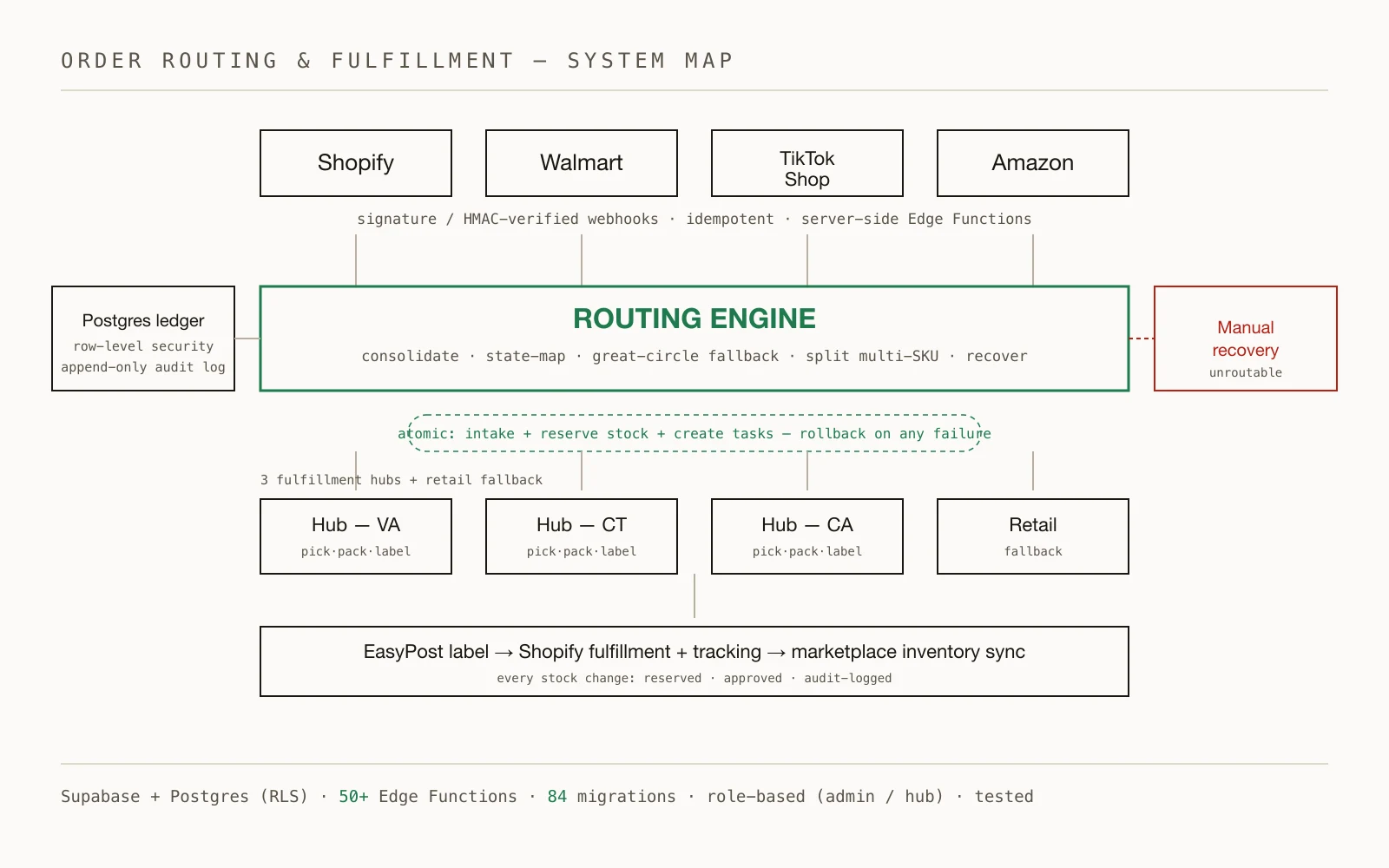
- Problem
- Multi-marketplace fulfillment was creating oversell risk, routing complexity, and manual recovery work.
- Build
- Routing engine, atomic inventory reservation, marketplace intake, labels, dashboards, RLS, and audit logs.
- Result
- The internal system now runs live fulfillment for my brand across Shopify, Walmart, TikTok Shop, and Amazon.
What it is
The operations backbone of my own brand: an internal app that takes in orders from Shopify, Walmart, TikTok Shop, and Amazon, routes each to the right fulfillment hub, reserves the stock, and drives the pick/pack/label/ship workflow — with admin and hub-worker dashboards. It runs the brand's fulfillment today, and I keep building on it.
What I built
- 01A deterministic routing engine: consolidate an order to one hub when possible, else map by state, fall back by great-circle distance to the nearest hub, or split a multi-SKU order across hubs — anything unroutable drops into a manual-recovery queue instead of vanishing.
- 02Atomic inventory reservation that guards against overselling — order intake, task creation, and the stock commit run as one transaction; if any leg fails, the whole thing rolls back.
- 03Order intake from four marketplaces via signature-verified webhooks, plus EasyPost label creation and Shopify fulfillment/tracking write-back and marketplace inventory sync.
- 04Two role-based surfaces: an admin dashboard (exceptions, alerts, channel health, pending approvals, audit trail) and a hub dashboard (picking with barcode scan, packing, labels, returns, adjustments).
- 05A security model that moved all critical inventory logic out of the browser into server-side Edge Functions, behind row-level security and admin/hub authorization, with every stock change audit-logged.
Business problem
Selling the same catalog across four marketplaces from multiple hubs is where DTC brands quietly bleed money — overselling, orders sent to the wrong hub, manual label chaos, and no clean audit trail. Off-the-shelf tools didn't fit how the brand actually ships, so I built the system it runs on.
My role
Sole architect and developer. Routing engine, database + security model, marketplace integrations, both dashboards, and the fulfillment workflow — all me.
Proof
- ✓Handles my own brand's live orders across four marketplaces today — and I keep building on it.
- ✓50+ server-side Edge Functions on Supabase; Postgres with row-level security (tests assert cross-role access is denied); 84 migrations; an audit + transaction log on every inventory change.
- ✓The routing engine is a pure, tested function (state-map + great-circle fallback + multi-hub split); tests cover routing, auth, RLS, and workflow boundaries.
What this proves
This proves I can build business-critical internal software where mistakes cost real money: deterministic routing, transactional stock reservation, marketplace integrations, exception handling, audit logs, and role-based security. It is not theory or a demo. It runs the operation I also own.