Range · Real-time multiplayer game · 2026
Killer Party
Solo-built a real-time murder-mystery product with public demo, private playtest funnel, QA-room proof, and a closed customer-hosting gate until launch evidence clears.
8/8
QA seats filled
3 acts
completed in QA
6
evidence cards revealed
325/327
current tests passing
- Problem
- A room-scale mystery needed shared TV state, private phone state, and enough launch proof to avoid selling a fragile party night.
- Build
- Second-screen architecture, deterministic reducer engine, private dossiers, demo route, playtest funnel, QA rooms, storefront plumbing, and launch gate.
- Result
- The product is live for public preview/demo and has QA-room proof, while real customer hosting stays deliberately closed until human table evidence clears.
Visual proof
Screens that show the work.
Cropped for the case study. Open the live link for the full production surface.
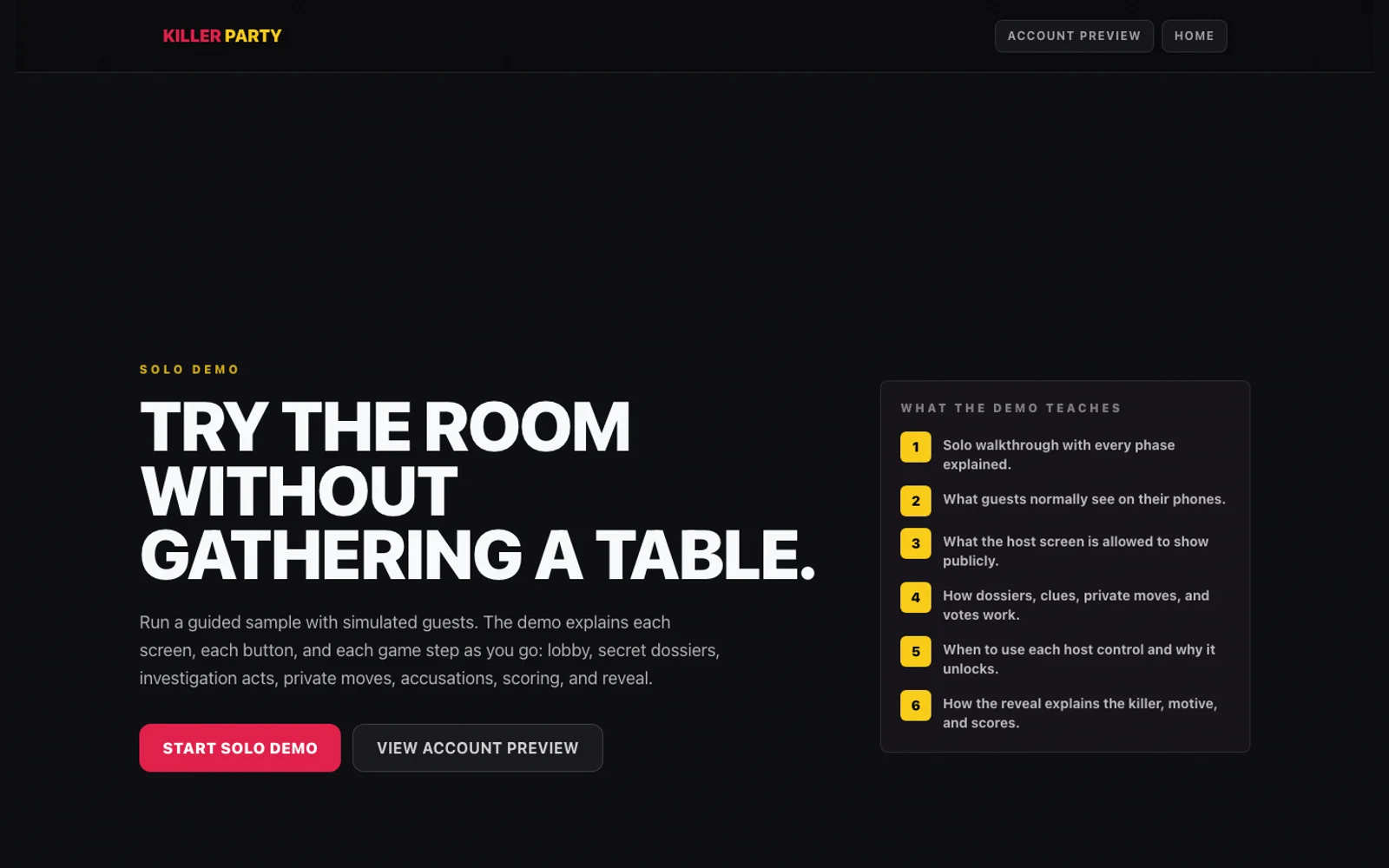
Guided solo demo
Public-safe route that walks through lobby, dossiers, evidence, private moves, accusations, scoring, and reveal.
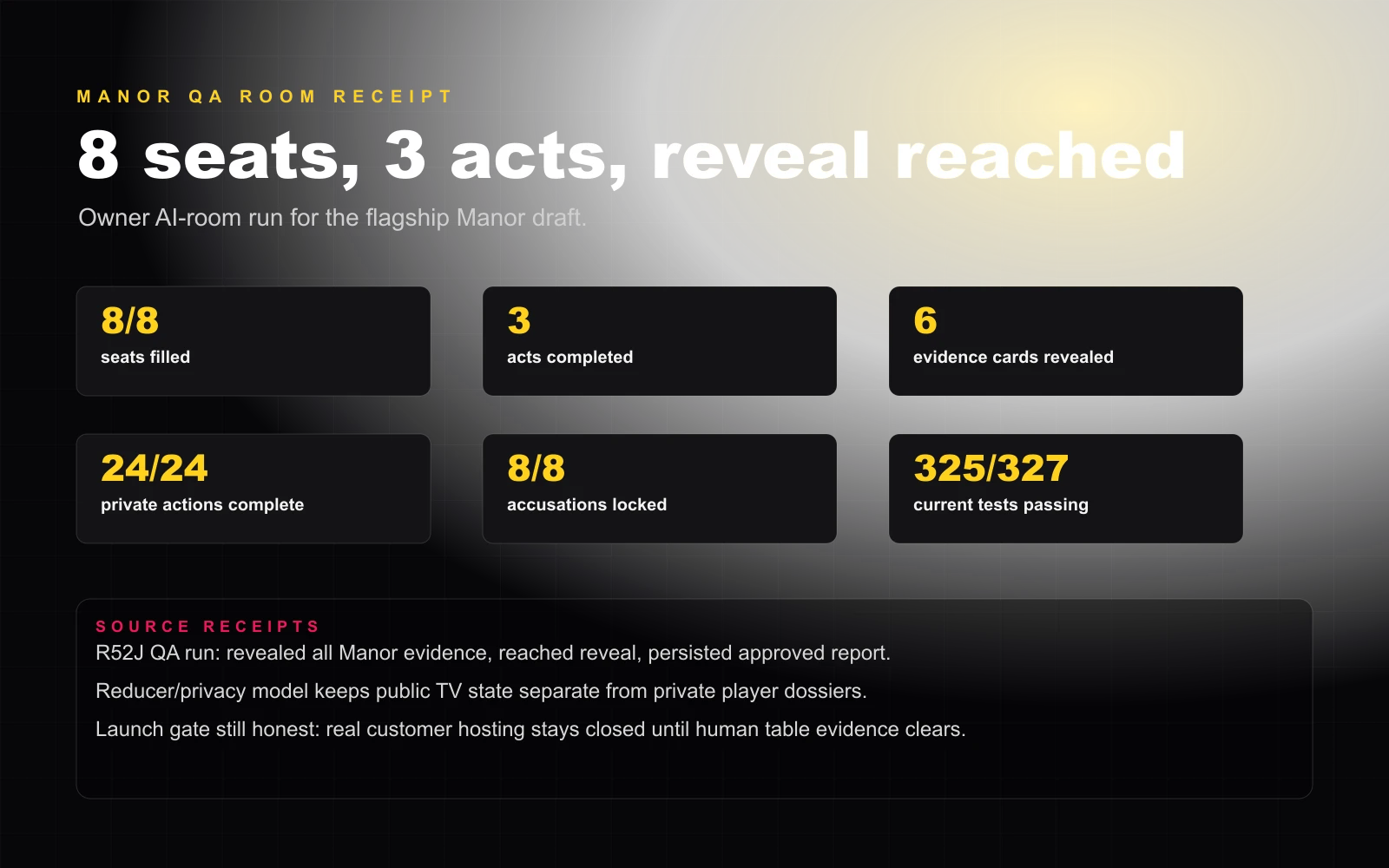
QA room receipt
Owner AI-room run: eight seats, three acts, six evidence cards, twenty-four private actions, eight accusations, reveal reached.
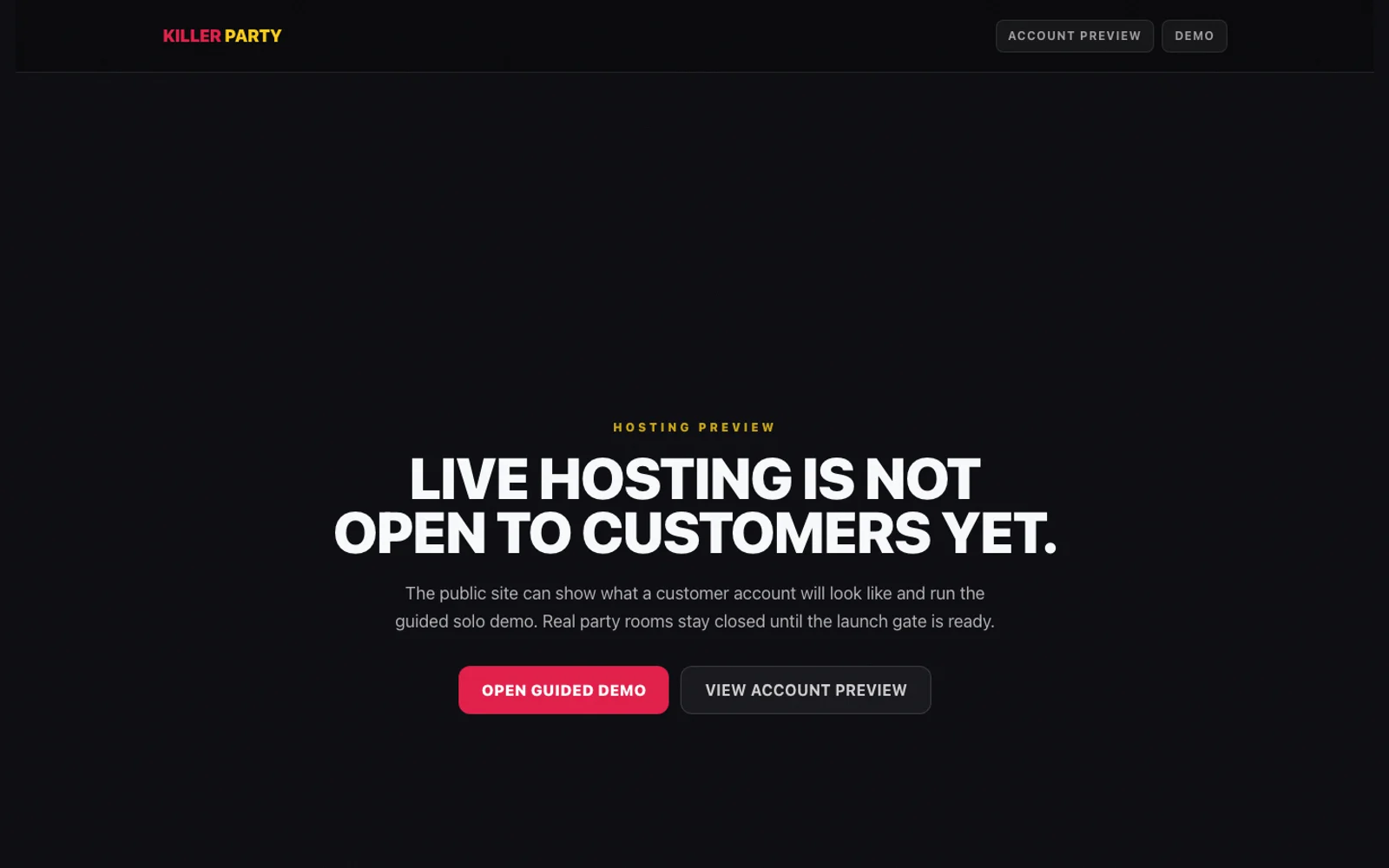
Launch gate
The product is honest about maturity: real customer hosting remains closed until human table evidence clears.

Flagship case pack
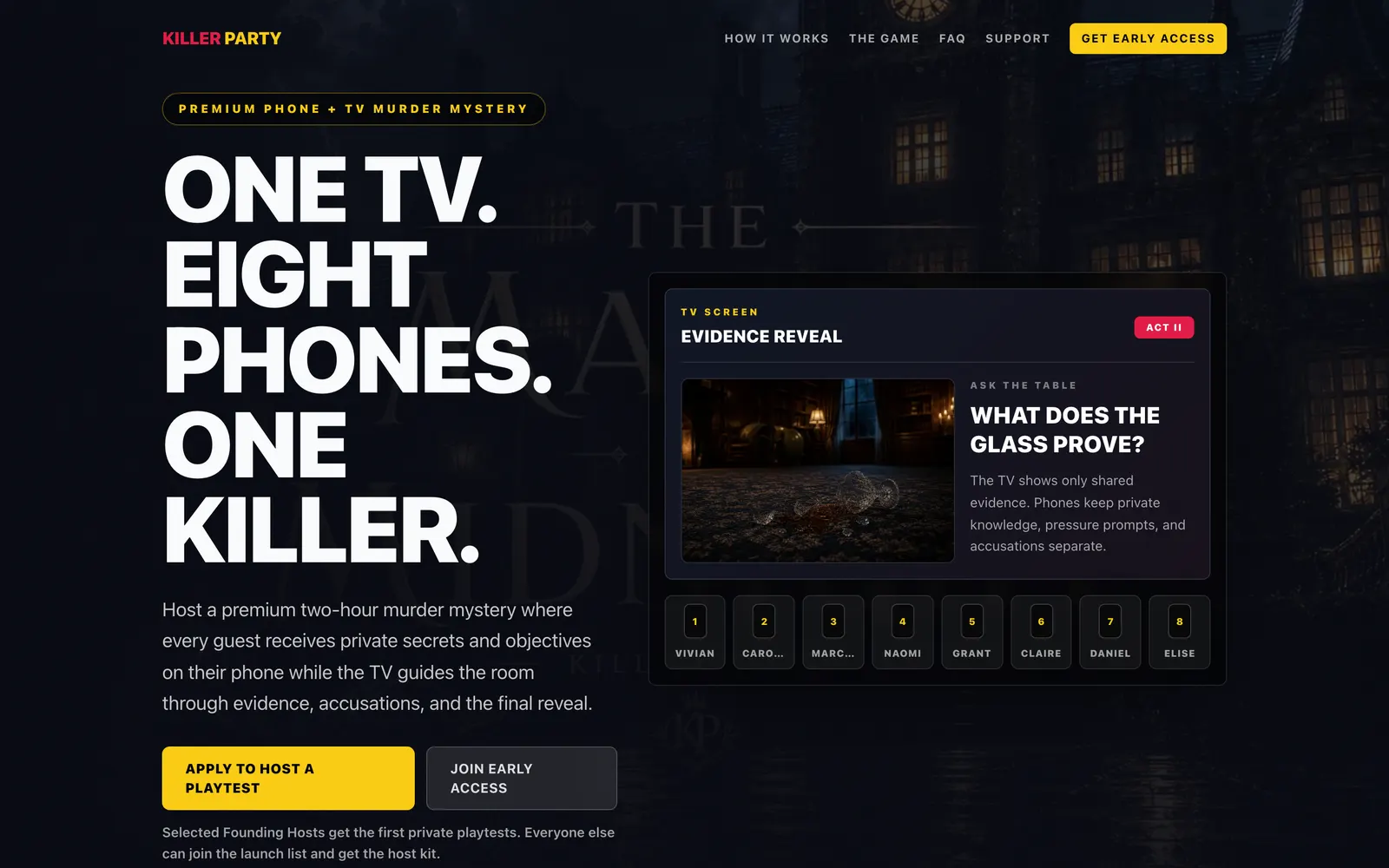
The Manor at Midnight pack art and product packaging for the first flagship mystery.
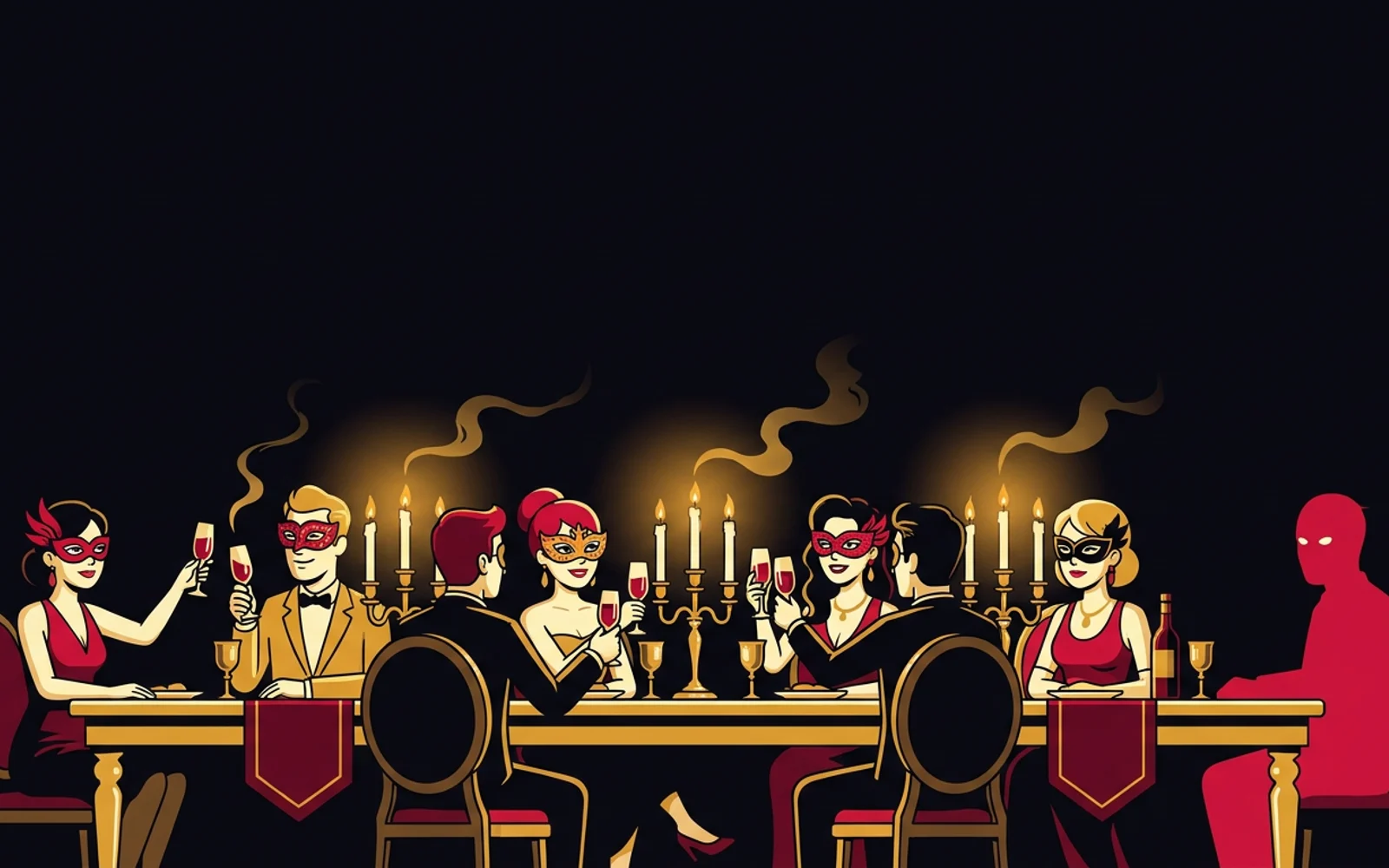
Table fantasy
The brand world the runtime serves: a social room game, not a one-person quiz screen.
Operating proof
The game loop under the landing page
Killer Party is strongest when the reader can see the system boundaries: the TV gets public state, each phone gets only its private dossier, and the host moves the room through the mystery.
Room
Host creates a room and shares the code.
Join
Players enter on phones; the TV sees only public lobby state.
Deal
Roles and dossiers are assigned without leaking the killer.
Evidence
The host reveals public evidence to the room.
Private moves
Phones receive private prompts, clues, and action choices.
Accuse
Votes lock privately before reveal.
Reveal
The host screen names the killer, motive, clue chain, and scores.
Receipts
- ✓R52J owner AI-room run filled 8/8 seats, completed all three acts, revealed all six Manor evidence cards, locked 8/8 accusations, and persisted an approved QA report.
- ✓Current local test run: 325 passing tests out of 327; two flagged tests are launch-gate seat-limit expectations, not the reducer/privacy core.
- ✓Live site explicitly keeps customer hosting closed until real human table evidence clears.
What it is
A premium party game you play in a room: one shared TV/host screen, phones for private player information, and a murder mystery that moves through roles, evidence, private prompts, accusations, scoring, and reveal. The public site is live with demo, account preview, waitlist/playtest surfaces, and a closed customer-hosting gate while launch evidence is still being collected.
What I built
- 01A phone-per-player + shared-TV-host (second-screen) architecture.
- 02A deterministic game-state engine so every phone and the TV stay in sync and the game resolves the same way every time.
- 03Private per-player role dossiers — each player only ever sees their own identity and information.
- 04The full play flow: evidence reveals, pressure prompts, and the accusation → killer-reveal sequence.
- 05A guided solo demo, private playtest launcher, waitlist/early-access funnels, account preview, and Shopify-backed commerce plumbing for the flagship pack.
- 06Owner QA tooling that can create rooms, fill CPU seats, run act progression, persist QA reports, and prove whether a mystery reaches reveal without manual rescue.
Business problem
Party games that run on a group's phones usually fall apart in practice: screens drift, secret roles leak, and someone becomes the unpaid referee. The harder business problem is trust before launch. A buyer needs to believe the game will work in a living room, and I need proof from demo, QA, and playtest gates before opening paid customer hosting.
My role
Creator & full-stack developer. Game design, real-time engine, front end, admin, storefront, tests — solo, every layer.
Proof
- ✓Live at playkillerparty.com with public demo, account preview, waitlist, early-access, and playtest surfaces.
- ✓The product does not overclaim paid launch: customer hosting is intentionally closed until the launch gate is ready.
- ✓R52J QA run: 8/8 seats filled, all three acts completed, all six rendered Manor evidence cards revealed, 24/24 private actions completed, 8/8 accusations locked, reveal reached.
- ✓Current local test run: 325 passing tests out of 327 across reducer, privacy boundaries, room/session, checkout, waitlist, QA, and commerce routes.
Success criteria
The launch standard
A party game only earns launch when it can survive a table. I treated the public site, game runtime, and launch gate as one product.
No sales, player-count, or revenue claims. Real customer hosting stays closed until human table evidence clears. Public screenshots use demo/seed/QA material only.
Sync
Keep the TV, host controls, and phones aligned through every phase.
- ✓Room code creates one shared room identity.
- ✓Public room state drives the TV and host surfaces.
- ✓Reducer state advances deterministically through lobby, briefing, acts, voting, and reveal.
Secrecy
Never leak a private role, clue, vote, or killer identity to the wrong screen.
- ✓Server-only room secret stores assignments and votes.
- ✓Player dossier is derived per player and merged only into that player's frame.
- ✓TV state is explicitly public and spoiler-safe before reveal.
Launch
Prove the room before taking real customer hosting live.
- ✓Guided demo explains the full product loop safely.
- ✓Owner QA rooms can fill seats, run acts, and persist reports.
- ✓Customer hosting remains gated until real human table testing clears.
What this proves
This proves I can design rules, state, trust boundaries, launch gates, storefront plumbing, and QA tooling as one product system. The maturity story is honest: the hard runtime exists, the public product is live for preview/demo, and paid customer hosting waits for the evidence a real room-scale game deserves.